|
To define Magic Realism as it applies to art is both a challenging
and elusive task. Those who embark on an exploration of this
topic soon experience feelings of disorientation, confusion or
even delirium. A veritable jungle of references exist for Magic
Realism, but most of those roadmaps charted in its formative period
are now outdated. Some pathways remain unexplored, while many others have long ago
become overgrown. Fortunately there has been considerable rethinking
about this subject in the past few decades, and a reevaluation of
its importance as an artistic movement is warranted.
If Magic Realism does exist between the two poles of realism (north) and
pure fantasy (south), we will need a metaphysical compass to assist
our exploration. Its
components would include artistic sensibilities,
acute powers of observation and a knowledge of the
traditions of art history. We are searching for paintings that are
sharply rendered,
cool and detached, and often pregnant with metaphoric or hidden
meanings, and which were created during the four decades following World War
I.
The term "Magic Realism" was coined by German art critic Franz Roh
in an essay written in 1924. Roh observed that during the
early 1920s many German artists were reintroducing real objects as
the center of attention in their paintings.
He established that there was a strong countermovement to
Expressionism in progress in German arts. In 1925 Gustav Hartlaub organized an
important exhibition of contemporary German art under the title of
Die Neue Sachlichkeit
(New Objectivity). This became the name that most
art historians have used when referring to the predominant styles of German
art during the Weimar years, but this movement is also thought to
have ended in 1933 with the ascendancy of National Socialism.
A major challenge exists to define Magic Realism's place in a
historical context. First, it is important to make a distinction
between the broad groupings of Neue Sachlichkeit and Magic Realism
within Germany. Initially, it seems evident that Franz Roh and
Gustav Hartlaub were surveying similar art. Hartlaub stated that
Neue Sachlichkeit covered two wings, including the rustic
classicalism of Georg Schrimpf on the
right and the socially critical verism of Otto Dix
and others on the left. However his exhibition heavily promoted the
more conservative painting of the Munich
artists. Roh initially referred to this
art as Post-Expressionism, but he also added
Magic Realism as a byname. He spoke of a "renewed delight in real
objects", and added that this new art seemed to offer "a calm
admiration of the magic of being; a question of representing before
our eyes, in an intuitive way, the fact, the interior figure, of the
exterior world". Roh identified seven separate sources for his
Magic Realism, and illustrated that it was a broad movement, also
developing in other European countries.
Although Magic Realism and Neue Sachlichkeit
seemed to encompass similar art at the time, art critic Emilio Bertonati
commented
several decades later that Magic Realism
should refer to a restricted concept, one in which subject
matter and content are important, not just style. The concepts
of Magic
Realism became more clearly defined
in the second half of the 1920s, as artists interacted with each
other and due to publications of Roh's essays in other languages. During the 1930s and
1940s the
movement spread throughout Europe as well as in the
Western Hemisphere. Magic Realism thus established itself as a broad
current, separating itself from Die Neue Sachlichkeit, which had to
evolved based on stylistic characteristics alone.
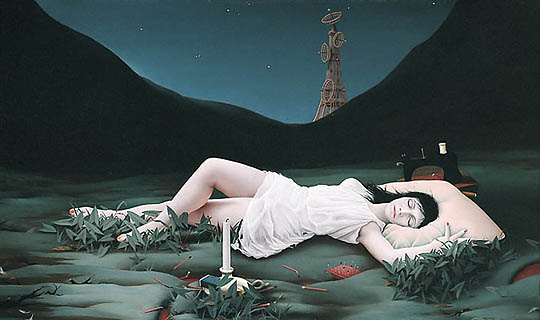
The subject matter of Magic Realism paintings include
commonplace objects from everyday life mixed with elements of the
fantastic,
drawing from the artist's imagination, interwoven into a
magical fabric. Many early works of Magic Realism were inspired by
the naive paintings of Henri Rousseau or by the Metaphysical
art of
Giorgio de Chirico, particularly his
paintings produced between 1910 and 1915. Other influences came from
a number of Italian contemporary
artists, including Felix Casorati and
Gino Severini. In France a few artists, notably
Felix Vallotton and Andre Derain,
moved decidedly away from styles of abstraction that had developed
just prior to World War I, employing a hard-edged and reinvented
approach to Realism. The influence of these Italian and French
contemporaries was connected to the Return to Order current within
Europe, the revival of interest in traditional painting techniques
and aesthetics.
The art of Neue Sachlichkeit has been characterized as a
photographically sharp style, yet early in the Weimar era paintings
exhibits selective use of finished details. Many paintings prior to
1925 exhibited a flatness or limited modeling of objects. Many of the aspiring artists of the day were
self taught. As the aesthetics of Neue Sachlichkeit became more
established, a number of artists found inspiration in the art of the
Northern Renaissance. Others were influenced by the Deutsch-Romers
or the German Romanticists. By the late 1920s, many works exhibited
an increasing mature style and a compelling realism.
Magic Realism often occurred when Das Unheimliche (roughly,
The Uncanny) combined with
a hard-edged realism of Neue
Sachlichkeit. Uncanny, strange or weird elements were frequently
added to the art during the Neue Sachlichket era. According to Sigmund Freud's 1919 interpretation, Das Unheimliche
could have a dual connotation. It
could refer to the familiar experienced in an unusual place (defamiliarization).
But it could also refer to concealed yet undesirable things being
revealed. The Uncanny can be seen in paintings by
Carl Grossberg and
Franz Sedlacek. It can also found in
Otto Dix's diverse output.
Influences of Symbolism and German Romanticism can also be seen in
some
of the paintings of the Weimar era. In
works by Franz Radziwill the atmosphere itself is
magically
strange, calm (airless) and creating a feeling of unnaturalness.
Christian Schad frequently packed his
paintings with metaphors. During the 1930s a lot of the magic in German art
disappeared mainly due to the rise of the National Socialism. Many artists outside Germany
however began adding
"magical" elements to their paintings. It became a
significant undercurrent in representational art during the 1930s, 40s
and 50s.
A central challenge in identifying Magic Realism
pertains to the
boundaries between Realism and pure fantasy. Magic Realist artists
often introduced unusual juxtapositions, eerie atmospheres and naive
elements into their art. Typically the Magic Realists dealt with
themes of isolation and alienation. Many of them studied the techniques of the Old
Masters, and used these to establish, and also to twist, the illusions of
reality. But they did not stray completely away from the real world. In the
words of Dutch artist Pyke Koch: "Magic Realism is based on the
representation of what is possible, but not probable".
The
term
Magic Realism was a little used in Germany. It was, however, soon
recognized by writers and artists outside of Germany, particularly
after 1930. Most notably American promoter Lincoln Kirstein brought
currency to the term when referring to the work of the American
Magic Realists of the 1930s and 40s. A number of artists, mainly
exhibiting in New York City, carried
the torch of Realism during the 1940s and 50s, in the heyday of
the Abstract Expressionism movement. Among them
Jared
French, Paul Cadmus,
George Tooker, Andrew Wyeth,
Alex Colville,
Henry Koerner and Robert
Vickrey were prominent.
Magic Realism in literature is related but quite distinct from the
movement in art. The artists of the 1920s moved
away from manifestations of the subjective toward a revitalized Realism.
The momentum in the literary movement which also adopted the name
Magic Realism moved in an opposite direction, away from Realism toward alternative
consciousness and frequently embracing the fantastic.
Once the concepts of Magic Realism are understood, it becomes
somewhat easier to identify and survey this type of art. We have compiled a "Time Capsule" of
Magic Realism, which includes related works that preceded the
movement beginning with the
Renaissance. We invite you to
tour the Time Capsule and hope that you enjoy your travels.
Enter the Magic Realism Time Capsule
By Georg Kremer
- Email:
editor@monograffii.com
|